Alexandrite
The color-changing miracle gem — green by day, red by night
Alexandrite Quick Facts
The History of Alexandrite
Alexandrite was discovered on April 17, 1834, in the emerald mines of the Ural Mountains in Russia, on the very day the future Tsar Alexander II came of age — earning the new gem his name. The Russian Imperial family adopted alexandrite as the national stone: its green daylight color and red incandescent light color matched the colors of the Russian military, making it instantly patriotic. The original Russian deposits were exhausted within decades, leaving Sri Lanka, Brazil, and East Africa as modern sources. Tiffany & Co. master gemologist George Frederick Kunz acquired most remaining Russian alexandrite in the 1890s, sparking a Western fashion for the gem in Belle Epoque jewelry. In 1987 a major find at the Hematita mine in Brazil reinvigorated supply, though high-quality alexandrite remains one of the rarest gemstones — finer than top-grade ruby in equivalent sizes.
Alexandrite Meaning & Symbolism
Alexandrite represents transformation, dual perspective, and the ability to adapt. Its color-shifting nature — green in daylight (rich in blue-green wavelengths), red under incandescent light (rich in red-yellow wavelengths) — has made it the gem of those who navigate complex situations with grace. In Russian mystical tradition, alexandrite is associated with intuition and the balance between body and spirit. Vedic astrology assigns it to Mercury, the planet of intelligence and adaptability. Modern crystal healers consider it the gem of personal evolution: wear alexandrite when you are in transition between life chapters. The dual color symbolizes the integration of opposites — joy and sorrow, head and heart, day and night.
Famous Alexandrites in History
The Sauer Alexandrite, a 122-carat Brazilian crystal, is the largest gem-quality alexandrite ever found. The Smithsonian's National Gem Collection holds an exceptional 65.7-carat alexandrite. The Whitney Alexandrite, a 17.08-carat Russian-Ural specimen, sits at the Smithsonian. In 2016 a 21.41-carat Russian alexandrite sold at Sotheby's for $1.4 million per carat, breaking records. Tiffany's 1900s alexandrite jewelry collection — including pieces designed by Louis Comfort Tiffany — remains among the most collectible gems of the Belle Epoque era.
How to Care for Alexandrite
Alexandrite is hard (Mohs 8.5), suitable for daily wear in any setting. Treatments are uncommon — most alexandrite on the market is natural. Synthetic alexandrite (created since 1973) is chemically identical and substantially cheaper; reputable sellers always disclose it. Clean with warm water, mild dish soap, and a soft brush. Ultrasonic cleaners are generally safe for unfractured stones. Store separately from softer gems. To see the color change clearly, view alexandrite first under direct daylight, then under a candle or incandescent bulb.
Names That Connect to Alexandrite
Alexandrite's Russian imperial heritage connects with names like Alexander (its namesake), Anastasia, and Tatiana — names rooted in tsarist Russia.
Alexandrite — Common Questions
Why is alexandrite so expensive?
Alexandrite is one of the rarest gemstones on Earth. The original Russian deposits exhausted by 1900; modern sources (Brazil, Sri Lanka, Tanzania) produce limited quantities. A clean alexandrite over 1 carat with strong color change can cost $15,000-50,000 per carat — sometimes exceeding diamond. The combination of rarity, hardness, and dramatic color change creates extreme value.
How dramatic is alexandrite's color change?
Top-quality alexandrite shifts from intense bluish-green (daylight, sunlight, fluorescent light) to red or purple-red (incandescent bulbs, candlelight). Lower-grade stones may show only subtle shifts. Gemological labs grade color change strength: "strong" (90-100%), "moderate" (60-90%), "weak" (30-60%). Strong-change stones are exponentially more valuable.
Is lab-grown alexandrite real alexandrite?
Yes — chemically identical to natural alexandrite. Lab-grown alexandrite has been produced commercially since 1973 and is available at 5-10% of natural prices. Reputable sellers always disclose synthetic origin. For everyday wear, lab-grown is an excellent practical choice; for collectors, natural Russian or Brazilian alexandrite holds investment value.
What zodiac signs benefit from alexandrite?
Alexandrite is one of June's three birthstones, making it natural for Geminis (May 21 – June 20) and Cancers (June 21 – July 22). In Vedic astrology it benefits Mercury-ruled signs: Gemini and Virgo. Adaptable, communication-driven personalities resonate with alexandrite's transformational energy.
How do I tell if my alexandrite is real?
True alexandrite shows a dramatic green-to-red color change between daylight and incandescent light — observable to the naked eye. Synthetic alexandrite shows the same change. Color-change garnet and synthetic corundum (created for the Russian military as alexandrite simulants) show weaker, less precise shifts. Gemological lab certification is the only definitive test.
Other Stones to Explore
More Cosmic Tools
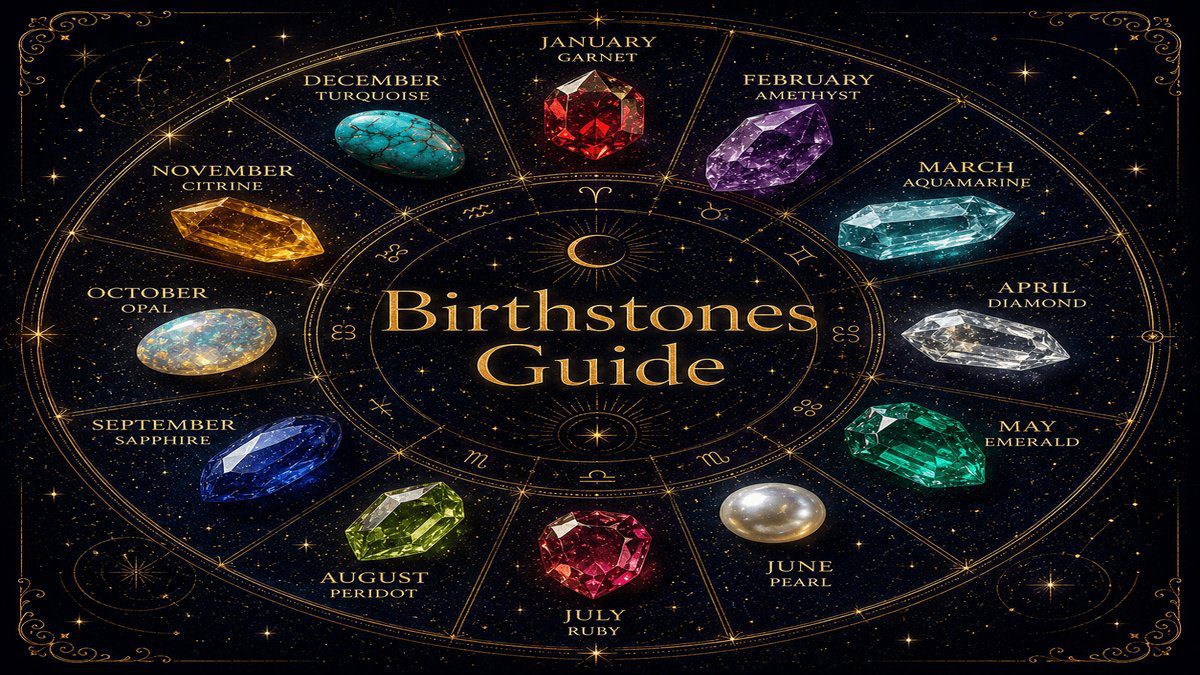
Find Your Birthstone by Birth Month
Each month has its own stone with unique meaning, history, and healing energy. Tap your birth month to discover yours in detail.