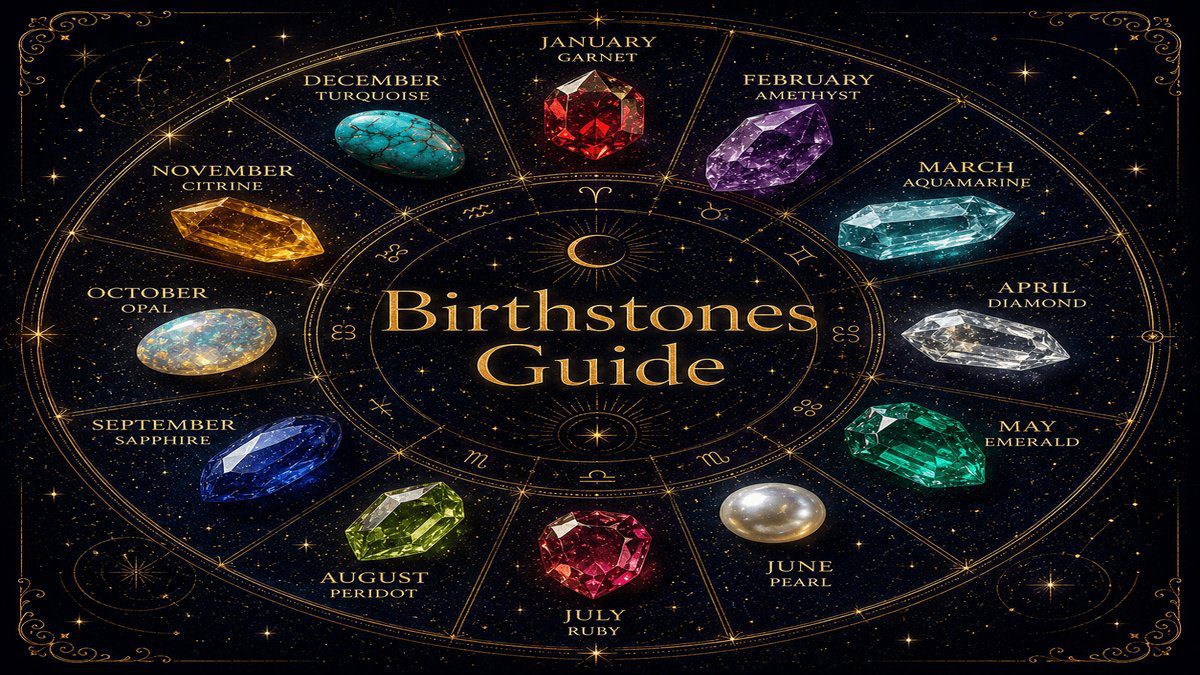
Birthstones by Month & Zodiac
Every birthstone for every birth month — modern, traditional, and mystical gemstones with full meanings, properties, and the 5,000-year history behind them.
What Is a Birthstone?
A birthstone is a gemstone associated with the month of a person\’s birth. Tradition holds that wearing your birthstone amplifies its healing, protective, or attracting qualities — properties that have been passed down through cultures for thousands of years. The system has roots in the Bible: the breastplate of the High Priest Aaron carried twelve stones representing the twelve tribes of Israel (Exodus 28:17-21). Over time, these twelve stones became associated with the twelve months of the year, then the twelve zodiac signs.
The modern Western birthstone list was standardized by the American National Association of Jewelers in 1912, with periodic updates as new gemstones were discovered or popularized — most recently in 2016 when spinel was added as an August birthstone. Today most months have one primary stone, but several months (June, August, October, November, December) have multiple official birthstones, giving buyers different price points and color preferences.
Beyond commercial standardization, three distinct birthstone traditions coexist. The Modern list (American Gem Trade Association) is what jewelers sell. The Traditional list dates to 15th-18th century Europe, with stones that were available before global trade made all gemstones accessible. The Mystical list comes from Tibetan Buddhist tradition, dating back over 1,000 years and based on energetic rather than commercial considerations. This guide includes all three for every month.
Find Your Birthstone by Month
Click your birth month for the full guide — modern, traditional, and mystical birthstones with meanings.
Birthstones for Each Zodiac Sign
How birth month gemstones connect to your astrological sign.
Birthstones Grouped by Color
Drawn to a specific color? Find every birthstone in that family.
White & Iridescent
Multi-color
Complete Birthstone Encyclopedia
Each stone has its own profile — history, properties, and meaning.
How to Choose Your Birthstone
By Birth Month
The traditional approach. Each month has a specific stone (or 2-3) — your birth month is the most direct connection.
By Zodiac Sign
If your birth month spans two zodiac signs, your astrological sign can guide which stone calls more strongly.
By Energy You Need
Each stone has associated qualities — courage (ruby), calm (aquamarine), abundance (citrine). Choose what you want to amplify.
By Color You Love
The most personal approach. Wear a stone whose color genuinely makes you happy when you see it. The energy follows your attention.
Should You Wear Your Birthstone?
✔ Why Yes
- Personal connection to your birth month
- Tradition of protection and luck across cultures
- Always meaningful birthday or anniversary gift
- Each stone has documented healing properties
- Easy conversation starter and self-expression
⚠ Things to Consider
- Some birthstones (diamond, ruby) are expensive
- Color may not suit your style preferences
- Modern vs traditional differs by month
- Pearls require gentle care (won\’t survive showers)
- Some stones (opal) are fragile and chip easily
Birthstones — Common Questions
What is a birthstone?
A birthstone is a gemstone associated with the month of a person\’s birth, traditionally believed to bring good luck, health, or specific qualities to the wearer. The system has biblical origins (the High Priest Aaron\’s breastplate) and was standardized in the modern Western form by the American National Association of Jewelers in 1912.
Why do some months have multiple birthstones?
Several months have more than one official birthstone — June (pearl, alexandrite, moonstone), August (peridot, spinel, sardonyx), October (opal, tourmaline), November (topaz, citrine), and December (tanzanite, turquoise, zircon). Multiple stones give buyers options at different price points and color preferences.
What\’s the difference between modern, traditional, and mystical birthstones?
Modern birthstones are the official list adopted by the American Gem Trade Association in 1912 and updated periodically. Traditional birthstones are the older European list, dating from the 15th-18th centuries. Mystical birthstones come from Tibetan Buddhist tradition, dating back over 1,000 years.
How do birthstones connect to zodiac signs?
Each birth month corresponds to one or two zodiac signs. Aries (March 21 – April 19) shares its birthstones with both March (aquamarine) and April (diamond). Some traditions assign separate gemstones directly to zodiac signs — for example, Aries is associated with bloodstone in some systems even though April\’s birthstone is diamond.
Should I wear my birthstone every day?
Most birthstones can be worn daily. Diamond, sapphire, ruby, and topaz are durable enough for everyday rings. Pearls, opals, and turquoise are more delicate and benefit from being removed before showers, swimming, or rough activities.
Can I wear someone else\’s birthstone?
Absolutely. Birthstones are traditions, not rules. Wearing a partner\’s, child\’s, or parent\’s birthstone is a deeply meaningful way to keep them close. Some people choose stones based on energy or aesthetics rather than birth month.
Which birthstone is the most expensive?
Among standard birthstones, certain rubies (especially Burmese pigeon-blood) and emeralds (Colombian Muzo) can exceed diamond per carat. Top-quality alexandrite is also exceptionally valuable due to extreme rarity. Within mass-market gem grades, diamond remains the most expensive on average.
What is the rarest birthstone?
Tanzanite is one of the rarest, found only in northern Tanzania near Mount Kilimanjaro. Alexandrite (the color-changing variety of chrysoberyl) is also extraordinarily rare. Top-grade Burmese ruby and Kashmir sapphire are considered rarer than most diamonds.
Do birthstones really have healing properties?
Birthstones have been associated with healing, protection, and energetic properties for thousands of years across cultures. Modern science does not validate these specific claims, but the practice of crystal healing and gem therapy remains widespread. Wearing a stone you find meaningful tends to have a real psychological effect, regardless of mineralogy.
How do I clean my birthstone jewelry?
Most hard birthstones (diamond, sapphire, ruby, topaz, garnet) clean safely with warm water and mild soap. Soft or porous stones (pearl, opal, turquoise) should only be wiped with a damp soft cloth — never soaked. Avoid ultrasonic cleaners with porous or organic stones (pearl, opal, amber). When in doubt, take it to a jeweler.
More Cosmic Tools
Find Your Birthstone by Birth Month
Each month has its own stone with unique meaning, history, and healing energy. Tap your birth month to discover yours in detail.