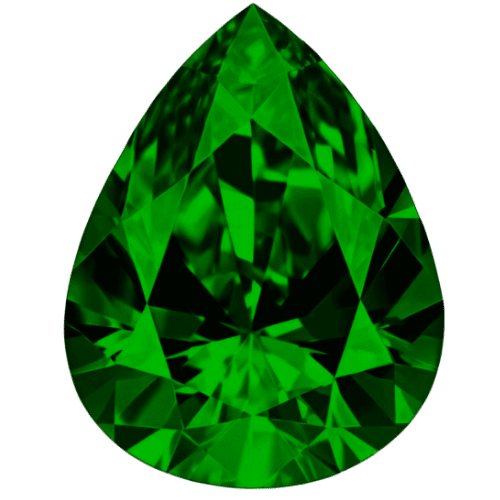
Emerald
The vivid green gem of rebirth, eternal love, and ancient royalty
Emerald Quick Facts
The History of Emerald
Emerald has been mined for at least 4,000 years — the Egyptian emerald mines of Cleopatra, located in the Eastern Desert near the Red Sea, were among the most heavily guarded sites in antiquity. Cleopatra wore emeralds in her crown and gave them as state gifts to visiting dignitaries; her own portrait collection included carved emerald cameos. The Spanish conquest of South America (1500s) dramatically reshaped the emerald trade when conquistadors discovered Colombia's Muzo and Chivor mines, which produced gems superior to the Egyptian deposits. Spanish galleons carrying Colombian emeralds back to Europe were repeatedly attacked by pirates; the wreck of the Nuestra Señora de Atocha (sunk 1622) yielded over 60,000 emeralds when discovered in 1985. The Mughal Emperor Shah Jahan (builder of the Taj Mahal) had 200+ emeralds carved with prayers from the Quran.
Emerald Meaning & Symbolism
Emerald represents rebirth, eternal life, and the vivid green of fertility. The Egyptians buried mummies with emeralds to ensure rebirth in the afterlife. In Greek mythology, emerald was sacred to Aphrodite and associated with romantic devotion. Christian tradition links emerald to the Holy Grail (in some accounts, the Grail was carved from a single massive emerald that fell from Lucifer's crown). In Vedic astrology, emerald corresponds to Mercury — the planet of communication and intellect — and is recommended for writers, students, and traders. Modern symbolism focuses on the heart chakra, unconditional love, and emotional balance.
Famous Emeralds in History
The Bahia Emerald is a 752-pound (341 kg) Brazilian rough emerald (over 180,000 carats) currently the subject of legal disputes in Brazil and California. The Mogul Mughal Emerald, a 217.8-carat emerald inscribed with Islamic prayers in the 1690s, sold at Christie's for $2.2 million in 2001. The Crown of the Andes, a 17th-century Colombian crown set with 450 emeralds (total weight 1,521 carats), now sits at the Metropolitan Museum of Art. Elizabeth Taylor's Bulgari emerald necklace, given to her by Richard Burton, sold for $6.6 million in 2011.
How to Care for Emerald
Emerald is hard (Mohs 7.5-8) but contains internal fractures and inclusions — the famous jardin ("garden") inclusions actually authenticate natural emerald. Most emeralds are oiled or resin-filled to enhance clarity; this is universally accepted but means emeralds need careful care. Never use ultrasonic or steam cleaners on emerald. Avoid prolonged exposure to hot water (which can wash out oil treatments). Clean only with warm water, mild soap, and a soft brush. Have emeralds re-oiled by a professional jeweler every 5-10 years if treatment fades.
Names That Connect to Emerald
Emerald's rebirth and verdant energy connect with names meaning olive tree, plant, and growth — Esmeralda literally means emerald in Spanish.
Emerald — Common Questions
Why are most emeralds oiled?
Natural emeralds contain internal fractures ("jardin") that reach the surface. Oiling fills these fractures and improves clarity by matching the light refraction. Cedarwood oil is traditional; modern resins (Opticon, Permasafe) are also used. Oiling is permanent enough for normal wear but can leak if the stone is heated or exposed to harsh chemicals.
Are Colombian emeralds the best?
Generally yes. Colombian emeralds (from Muzo, Chivor, and Coscuez mines) are prized for their pure grass-green color without bluish tones, and are considered the world's finest. Zambian emeralds are deeper green-blue and excellent in their own right. Brazilian emeralds are typically lighter or yellowish. Origin certification adds significant value.
Can lab-grown emeralds be told from natural?
By gemologists, yes — lab-grown emeralds (Chatham, Gilson, Biron) lack the natural jardin inclusions and have different growth patterns visible under magnification. Visually, lab-grown emeralds often appear cleaner and more saturated than equivalent natural stones. Always request disclosure.
What does emerald symbolize in love?
Emerald has been the gem of romantic devotion for over 2,000 years. The Greeks associated it with Aphrodite. In medieval Europe it was given as a token of fidelity. The 55th wedding anniversary is the emerald anniversary. Many engaged couples choose emerald as a colored alternative to diamond, signaling depth of feeling beyond convention.
How can I tell if my emerald is real?
Real emeralds always have internal jardin (some inclusions visible under 10x magnification — perfectly clean stones are usually synthetic or imitation). Real emeralds have a Mohs hardness of 7.5-8 and refract light specifically. The best confirmation is a certificate from a recognized lab (GIA, AGL, Gübelin).
Other Stones to Explore
More Cosmic Tools
Find Your Birthstone by Birth Month
Each month has its own stone with unique meaning, history, and healing energy. Tap your birth month to discover yours in detail.
💎 Bringing Emerald Into Your Practice
Reading about Emerald activates one part of you. Holding Emerald activates an entirely different part. Ancient cultures across continents independently established the same truth: the stone in the hand does what the stone in the mind cannot.
Choose Your Format
- Tumbled Emerald ( to 14) for pocket carry and meditation.
- Raw Emerald ( to 32) most powerful energetically for altar or desk.
- Emerald Bracelet ( to 35) daily-wear, energy active 24/7.
- Emerald Pendant ( to 45) over heart chakra for emotional work.
Authenticity Quick Check
Verify: weight (denser than expected), temperature (cool in palm 30+ sec), color depth (natural variation, not uniform). Avoid mixed-category sellers and prices under .
Caring for Your Stone
Emerald absorbs ambient energy continuously. Weekly cleansing required. The simplest tool: a Selenite charging plate ( to 22). Place crystals on it overnight. See our complete cleansing guide for 6 more methods.