Tourmaline
The rainbow gem of multiple colors — sometimes all in one stone
Tourmaline Quick Facts
The History of Tourmaline
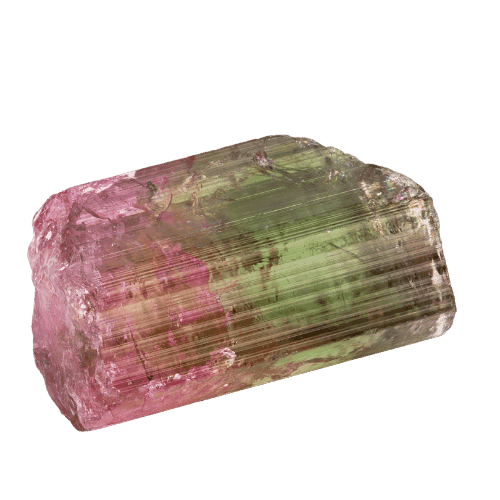
Tourmaline has confused gem traders for centuries because it appears in nearly every color — green, pink, red, blue, yellow, black, multicolored. Spanish conquistadors found green tourmaline in Brazil in the 1500s and assumed it was emerald; the misidentification persisted for 300 years until 1800s gemologists identified it as a separate species. The name comes from the Sinhalese (Sri Lankan) word turamali, meaning "stone of mixed colors." Empress Dowager Cixi of China (1835-1908) loved pink tourmaline so much that she imported it from Mount Mica, Maine, USA — making this New England mountain the source of an empress's collection. The 1989 discovery of Paraíba tourmaline in Brazil — neon turquoise-blue tourmaline colored by copper — revolutionized the gem market; Paraíba tourmaline now sells for more per carat than emerald. Watermelon tourmaline (pink core in green skin) shows nature's color transition in a single crystal.
Tourmaline Meaning & Symbolism
Tourmaline is the gem of all chakras simultaneously — different colors of tourmaline are associated with different energy centers. Black tourmaline (schorl) is one of the most-recommended crystals for grounding and protection from negative energy. Pink tourmaline corresponds to the heart chakra and softer feminine energy. Watermelon tourmaline integrates multiple chakras at once. Tourmaline is pyroelectric and piezoelectric — it generates electrical charge under heat or pressure, a property scientifically documented since the 18th century. This electrical nature is why traditional Dutch sailors used heated tourmaline to attract dust from their pipes (calling it Aschentrekker — "ash puller"). Modern crystal healing uses these electrical properties as part of its energy-clearing reasoning.
Famous Tourmalines in History
The Rockefeller Tourmaline — a 32-carat green Brazilian crystal — sits at the American Museum of Natural History. The Empress Cixi pink tourmaline collection from Maine USA still circulates among Asian art auctions, with individual pieces selling for $1-5 million. The Hauptmann Tourmaline, a 62-carat Brazilian Paraíba tourmaline, sold privately for over $25 million in 2018, making it among the most expensive single gemstones ever traded. Brazilian Paraíba tourmaline regularly sells for $20,000-100,000 per carat for top quality — exceeding emerald and even some sapphire prices.
How to Care for Tourmaline
Tourmaline is durable (Mohs 7-7.5), suitable for daily wear. Some tourmalines (especially heated bi-color stones) are more fragile than others. Avoid ultrasonic and steam cleaners — the sudden temperature changes can crack the gem. Clean with warm water, mild soap, and a soft brush. Avoid harsh chemicals. Store separately from harder gems. Heat treatment is common (universally accepted in the trade) and stable; irradiation treatment to enhance pink color is also stable.
Names That Connect to Tourmaline
Tourmaline's rainbow nature resonates with names meaning multiple colors or beauty — Iris (rainbow goddess), Aurora (dawn colors), Violet, Rose.
Tourmaline — Common Questions
What is Paraíba tourmaline?
Paraíba tourmaline is a rare neon turquoise-to-electric-blue variety colored by copper, first discovered in 1989 in the Brazilian state of Paraíba. The gem revolutionized the tourmaline market — Paraíba tourmaline routinely sells for $20,000-100,000 per carat, more than emerald or even some sapphire. Smaller deposits later found in Mozambique and Nigeria produce gems sold under broader "Paraíba-type" classification.
What is watermelon tourmaline?
Watermelon tourmaline is a single crystal showing pink in the center with green on the outside — like a watermelon slice. The phenomenon results from changes in trace elements during the crystal's growth. Slices are often cut perpendicular to the crystal axis to display this color zoning. Watermelon tourmaline is highly collectible and treasured for its natural beauty.
How many colors does tourmaline come in?
Tourmaline appears in more colors than any other gem species — virtually the entire visible spectrum. Major varieties include rubellite (red), indicolite (blue), verdelite (green), schorl (black), watermelon (bi-color), Paraíba (neon blue), achroite (colorless), and dravite (brown). Some tourmalines change color depending on viewing angle (pleochroism).
Why is tourmaline an October birthstone?
Tourmaline became an October birthstone in 1952, joining opal as a more affordable alternative. The reasoning: tourmaline's color variety lets people choose any color of October stone, while opal could be expensive. Both stones are now official October birthstones — modern lists include both.
Can tourmaline be worn every day?
Yes. Tourmaline's hardness (7-7.5) and toughness make it suitable for daily wear. Avoid extreme temperature changes. Clean gently with warm water and mild soap. Some bi-color and heat-treated tourmalines are slightly more fragile — ask your jeweler about specific care for your stone.
Other Stones to Explore
More Cosmic Tools
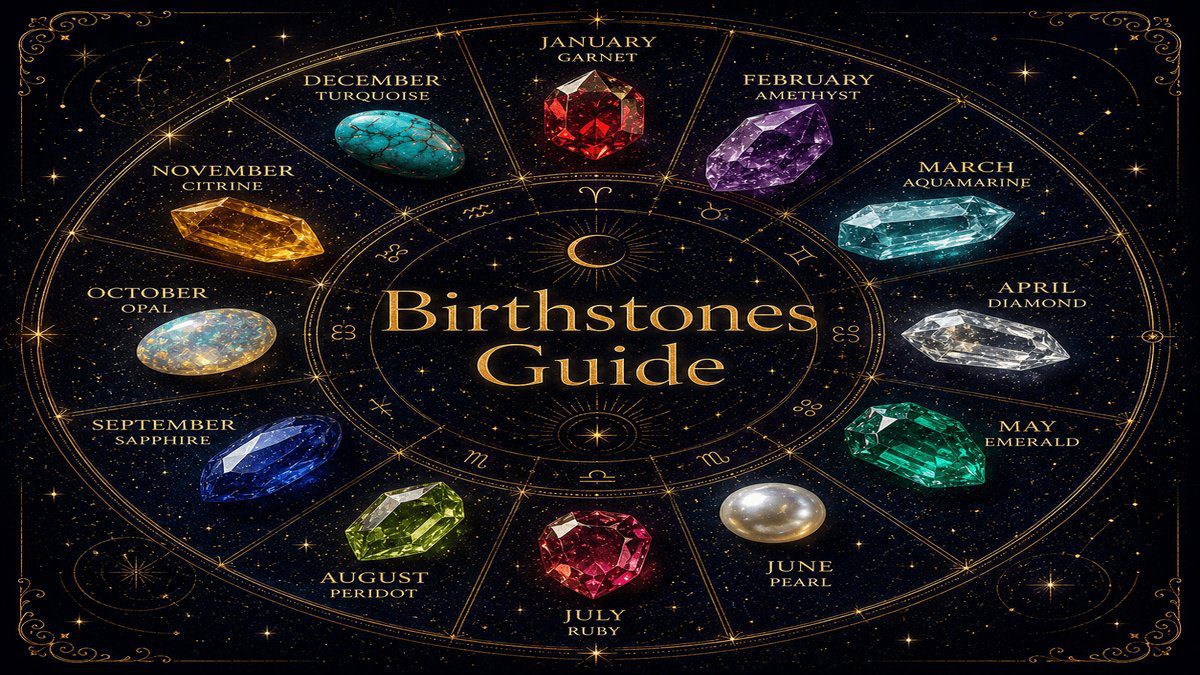
Find Your Birthstone by Birth Month
Each month has its own stone with unique meaning, history, and healing energy. Tap your birth month to discover yours in detail.
💎 Bringing Tourmaline Into Your Practice
Reading about Tourmaline activates one part of you. Holding Tourmaline activates an entirely different part. Ancient cultures across continents independently established the same truth: the stone in the hand does what the stone in the mind cannot.
Choose Your Format
- Tumbled Tourmaline ( to 14) for pocket carry and meditation.
- Raw Tourmaline ( to 32) most powerful energetically for altar or desk.
- Tourmaline Bracelet ( to 35) daily-wear, energy active 24/7.
- Tourmaline Pendant ( to 45) over heart chakra for emotional work.
Authenticity Quick Check
Verify: weight (denser than expected), temperature (cool in palm 30+ sec), color depth (natural variation, not uniform). Avoid mixed-category sellers and prices under .
Caring for Your Stone
Tourmaline absorbs ambient energy continuously. Weekly cleansing required. The simplest tool: a Selenite charging plate ( to 22). Place crystals on it overnight. See our complete cleansing guide for 6 more methods.