
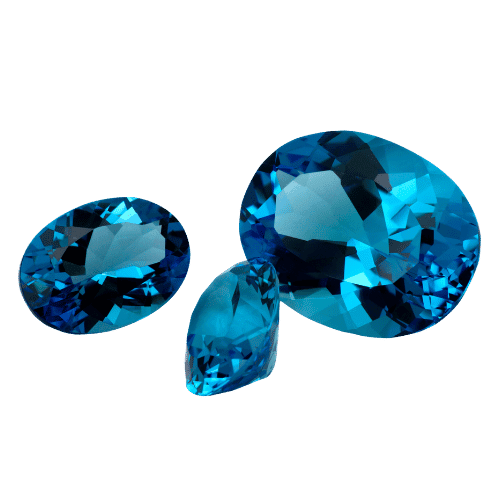
Aquamarine
The sea-blue gem of calm courage, sailors, and steady love
Aquamarine Quick Facts
The History of Aquamarine
Aquamarine — Latin for water of the sea — has been the talisman of sailors for over 2,000 years. Roman naval crews carried small aquamarines to ensure safe passage and calm waves. The Greeks and Romans engraved tiny aquamarine intaglios with the image of Poseidon (Neptune to the Romans) for protection at sea. The largest cut aquamarine in history is the Dom Pedro, a 4.5-pound (10,363-carat) Brazilian piece sculpted by Bernd Munsteiner in the 1990s, now displayed at the Smithsonian. Aquamarine belongs to the beryl family (along with emerald, morganite, and heliodor) — the same crystalline structure colored differently by trace impurities. The most valuable aquamarines come from Brazil's Minas Gerais state, with secondary sources in Madagascar, Pakistan, and Russia.
Aquamarine Meaning & Symbolism
Aquamarine represents calm communication, emotional clarity, and the courage that comes from knowing yourself. The pale blue color was associated by Greeks with Aphrodite when she was born from the foam of the sea. Renaissance Europeans believed aquamarine was the source of the Holy Grail's healing power. In Hindu astrology, aquamarine is recommended for those needing softer communication and emotional regulation. Modern brides sometimes choose aquamarine engagement rings as alternatives to diamond — symbolizing a love that flows like water rather than locks like stone. The gem is associated with the throat chakra and with finding the right words.
Famous Aquamarines in History
The Dom Pedro Aquamarine — sculpted from a 4.5-pound rough crystal — is the world's largest cut aquamarine, displayed at the Smithsonian since 2012. The Hirsch Aquamarine, a 109.92-carat brilliant cut, sold at Christie's in 2011. Eleanor Roosevelt's aquamarine necklace (gift from the President of Brazil during a state visit) has been on display at the Roosevelt Library in Hyde Park. The Espirito Santo Aquamarine, a 2,680-carat Brazilian crystal, is also displayed at the American Museum of Natural History.
How to Care for Aquamarine
Aquamarine is durable (Mohs 7.5-8) and suitable for daily wear. Heat treatment is common (changing greenish-yellow stones to pure blue) and accepted in the trade. Aquamarine is more stable than blue topaz under UV exposure. Clean with warm water and mild soap; ultrasonic cleaners are generally safe but should be avoided for fracture-filled or oiled stones. Store separately from harder gems (sapphire, ruby) to prevent scratching.
Names That Connect to Aquamarine
Aquamarine's water-clear calm resonates with names meaning sea (Marina), air/melody (Aria), peace (Olivia), and ocean (Kai).
Aquamarine — Common Questions
What gives aquamarine its blue color?
Aquamarine gets its blue color from trace amounts of iron (Fe²⁺) in the beryl crystal lattice. Pure beryl is colorless. Other forms of beryl include emerald (chromium = green) and morganite (manganese = pink). Greenish aquamarine is heat-treated to produce the more desirable pure-blue color.
Are aquamarine and topaz the same?
No — they are different minerals, often confused because both can be light blue. Aquamarine is a beryl (same family as emerald). Topaz is its own mineral. The differences: aquamarine has higher refractive index and slightly different crystal structure. Light blue topaz is usually irradiated; aquamarine's blue is more natural.
Is aquamarine valuable?
Aquamarine values vary widely. Pale stones with weak color sell for $50-100 per carat. Medium-saturation stones sell for $150-500 per carat. The most prized aquamarines — deep saturated cornflower blue, well-cut, eye-clean, and over 5 carats — can sell for $500-2,500 per carat. Origin (Santa Maria mine, Brazil) adds significant premium.
Can aquamarine be worn daily?
Yes. Aquamarine's hardness (Mohs 7.5-8) makes it suitable for daily wear in any setting. It is more durable than tanzanite and most colored gems. Clean regularly with warm water and mild soap. Avoid sudden temperature changes.
Why is March the aquamarine birth month?
Aquamarine has been the March birthstone in the modern American list since 1912. The traditional birthstone for March was bloodstone, which is still listed as March's mystical/alternative stone. The connection between aquamarine and March may reflect the season of melting waters — early spring in the Northern Hemisphere.
Other Stones to Explore
More Cosmic Tools
Find Your Birthstone by Birth Month
Each month has its own stone with unique meaning, history, and healing energy. Tap your birth month to discover yours in detail.
Famous Aquamarine Jewels in History
The most legendary Aquamarine specimens have shaped history through royal courts, museums, and cultural lore:
Dom Pedro Aquamarine (10,363 carats)
Worlds largest faceted aquamarine, displayed at Smithsonian Natural History Museum.
Hirsch Aquamarine (109 carats)
Cushion-cut blue aquamarine in Hirsch Collection.
Queen Mary Aquamarine Tiara
British royal tiara made for Queen Mary in 1911 with prominent aquamarines.
Geological Properties of Aquamarine
- Variety of beryl mineral (same family as emerald) colored by iron
- Hardness 7.5-8 on Mohs scale - durable for daily wear
- Largest aquamarine crystal ever found was 110 cm long in Brazil 1910
- Heat treatment enhances blue color - standard industry practice
- Madagascar, Brazil, Pakistan, and Mozambique are primary sources
💎 Bringing Aquamarine Into Your Practice
Reading about Aquamarine activates one part of you. Holding Aquamarine activates an entirely different part. Ancient cultures across continents independently established the same truth: the stone in the hand does what the stone in the mind cannot.
Choose Your Format
- Tumbled Aquamarine ( to 14) for pocket carry and meditation.
- Raw Aquamarine ( to 32) most powerful energetically for altar or desk.
- Aquamarine Bracelet ( to 35) daily-wear, energy active 24/7.
- Aquamarine Pendant ( to 45) over heart chakra for emotional work.
Authenticity Quick Check
Verify: weight (denser than expected), temperature (cool in palm 30+ sec), color depth (natural variation, not uniform). Avoid mixed-category sellers and prices under .
Caring for Your Stone
Aquamarine absorbs ambient energy continuously. Weekly cleansing required. The simplest tool: a Selenite charging plate ( to 22). Place crystals on it overnight. See our complete cleansing guide for 6 more methods.