Diamond
The hardest gem on Earth — symbol of unbreakable commitment
Diamond Quick Facts
The History of Diamond
Diamonds are 1 to 3.5 billion years old, formed deep in Earth's mantle at depths of 100-200 km, then carried to the surface by ancient volcanic eruptions. The first diamonds were mined in India along the Krishna River around 4 BC and were treasured for their supernatural hardness — the Sanskrit word for diamond, vajra, also means thunderbolt. Roman naturalist Pliny the Elder wrote in the 1st century AD that diamond was the most valuable substance in the universe. The Indian monopoly on diamond supply lasted nearly 2,000 years until Brazilian discoveries in 1725 and South African strikes in 1867 reshaped the global market. The De Beers diamond cartel was founded in 1888; their 1947 advertising campaign — "a diamond is forever" — singlehandedly created the modern engagement-ring tradition that did not exist before that decade.
Diamond Meaning & Symbolism
Diamond's name comes from the Greek adamas, meaning unconquerable, untamable. Across cultures the gem represents what cannot be broken: unwavering love, mental clarity, divine truth. In Hindu tradition diamond is associated with the planet Venus and is given to bring spiritual purity. Medieval Europeans believed diamond made warriors invincible in battle. In modern crystal healing, diamond is considered the "master healer" — said to amplify the energy of every other stone it touches. The colorless variety symbolizes the kind of clarity that cuts through illusion; colored diamonds (pink, blue, yellow) carry their own meanings tied to chakras and emotional states.
Famous Diamonds in History
The Hope Diamond — a 45.52-carat deep-blue diamond now at the Smithsonian — is rumored to bring misfortune to its owners (multiple deaths and ruin documented over 400 years). The Cullinan Diamond, found in 1905 South Africa at 3,106 carats raw, was cut into nine major stones now in the British Crown Jewels. The Koh-i-Noor ("Mountain of Light") was passed between Mughal, Persian, Afghan, and Sikh rulers before settling into the British monarch's crown — and remains controversial. The Pink Star, a 59.6-carat oval, sold for $71.2 million in 2017, the highest price ever paid for any gemstone at auction.
How to Care for Diamond
Diamond is the hardest natural substance (Mohs 10) — only another diamond can scratch it. Despite this, diamonds can chip if hit at the right angle along their cleavage planes. Clean with warm water, dish soap, and a soft brush. Ultrasonic and steam cleaners are safe for solitaires but risky for fancy-cut or fracture-filled stones. Store separately so the diamond does not scratch other gems. Have prongs checked annually by a jeweler — most diamond losses come from worn settings, not stone damage.
Names That Connect to Diamond
The clarity and unbreakable strength of Diamond resonate with names meaning star, light, royal, and unbreakable spirit.
Diamond — Common Questions
Why is diamond so expensive?
Diamond's price reflects its rarity, the difficulty of mining (about 250 tons of ore must be processed for a single carat), the controlled distribution (De Beers controlled 80-90% of the market for most of the 20th century), and the cultural marketing that established diamond as the engagement-ring standard. Lab-grown diamonds, identical molecularly, are now 30-50% cheaper than mined diamonds.
Are lab-grown diamonds real diamonds?
Yes. Lab-grown diamonds are chemically and optically identical to mined diamonds — same crystalline carbon structure, same hardness, same brilliance. The only difference is origin. Major jewelers including De Beers now sell lab-grown diamonds at lower prices than mined equivalents.
What does the 4 Cs mean for diamonds?
Cut, Color, Clarity, and Carat weight. Cut measures how well the diamond is faceted (most important for sparkle). Color grades from D (colorless) to Z (yellow). Clarity ranks internal inclusions. Carat is weight (1 carat = 200mg). The GIA grading system is the global standard.
Can diamond be damaged?
Yes. Despite hardness, diamond has perfect cleavage along certain planes. A sharp blow at the wrong angle can chip a diamond. Do not wear diamond jewelry during heavy lifting, sports, or tasks involving impact. Surface scratches are nearly impossible (only diamond scratches diamond), but chips and cracks are real risks.
Is April the only month with diamond as birthstone?
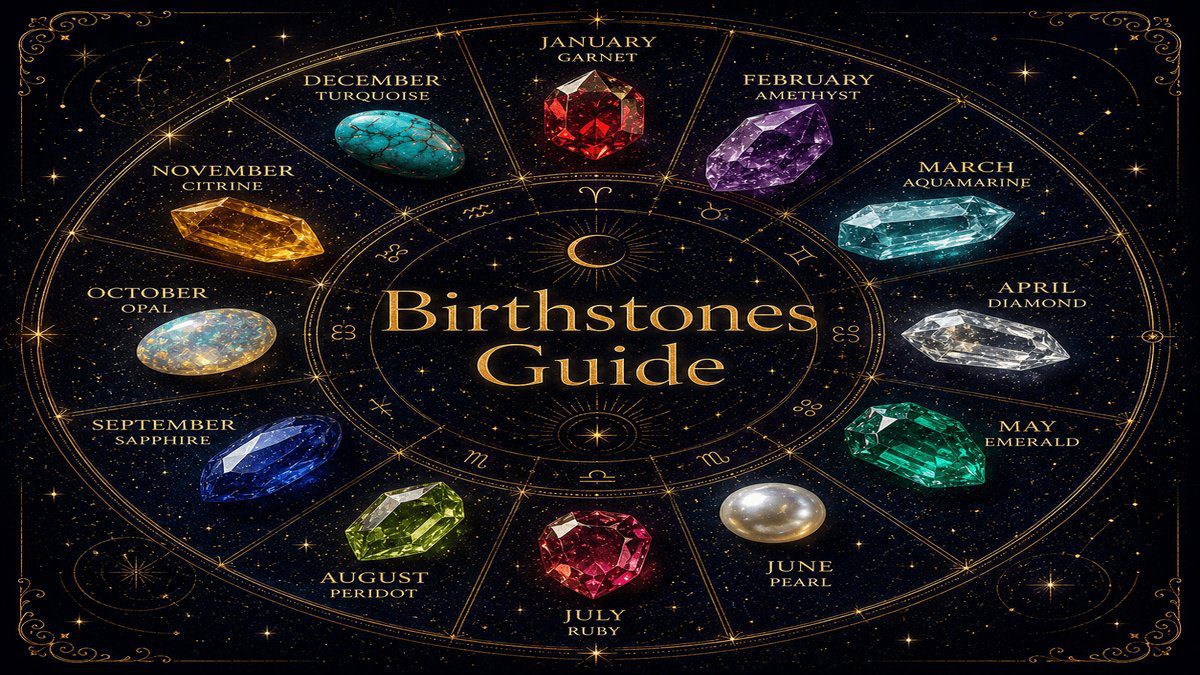
April's primary modern birthstone is diamond. The mystical Tibetan tradition assigns diamond to August. Some zodiac systems associate diamond with Aries (March 21 – April 19) and Taurus (April 20 – May 20).
Other Stones to Explore
More Cosmic Tools
Find Your Birthstone by Birth Month
Each month has its own stone with unique meaning, history, and healing energy. Tap your birth month to discover yours in detail.
Famous Diamond Jewels in History
The most legendary Diamond specimens have shaped history through royal courts, museums, and cultural lore:
Hope Diamond (45.52 carats)
Cursed deep blue diamond at Smithsonian. Originally from India in 1600s, owned by Louis XIV and later by Evalyn Walsh McLean before being donated to the museum.
Cullinan Diamond (3,106 carats rough)
Largest gem-quality diamond ever found in South Africa 1905. Cut into 9 major stones including Great Star of Africa in British Crown Jewels.
Koh-i-Noor (105 carats)
Ancient Indian diamond now in Queen Mothers Crown. India, Pakistan, Iran, Afghanistan all claim ownership.
Geological Properties of Diamond
- Pure carbon crystallized in cubic system, hardest natural mineral at 10 on Mohs scale
- Forms 150-200 km deep in Earth mantle under extreme heat and pressure
- Volcanic eruptions bring kimberlite pipes containing diamonds to surface
- Synthetic diamonds developed in 1950s now indistinguishable from natural
- Color range: colorless, blue, yellow, pink, green, black - rare colors are most valuable
💎 Bringing Diamond Into Your Practice
Reading about Diamond activates one part of you. Holding Diamond activates an entirely different part. Ancient cultures across continents independently established the same truth: the stone in the hand does what the stone in the mind cannot.
Choose Your Format
- Tumbled Diamond ( to 14) for pocket carry and meditation.
- Raw Diamond ( to 32) most powerful energetically for altar or desk.
- Diamond Bracelet ( to 35) daily-wear, energy active 24/7.
- Diamond Pendant ( to 45) over heart chakra for emotional work.
Authenticity Quick Check
Verify: weight (denser than expected), temperature (cool in palm 30+ sec), color depth (natural variation, not uniform). Avoid mixed-category sellers and prices under .
Caring for Your Stone
Diamond absorbs ambient energy continuously. Weekly cleansing required. The simplest tool: a Selenite charging plate ( to 22). Place crystals on it overnight. See our complete cleansing guide for 6 more methods.