Amethyst
The purple gem of clarity, sobriety, and spiritual protection
Amethyst Quick Facts
The History of Amethyst
Amethyst was once one of the five cardinal gems alongside diamond, ruby, sapphire, and emerald — until massive Brazilian deposits were discovered in the 19th century, dropping its commercial price dramatically while keeping its symbolic status intact. The Greek name a-methystos translates to not drunken: ancient Greeks believed amethyst protected the wearer from intoxication. They carved drinking cups from amethyst, believing that wine in such cups could not make them drunk. Greek mythology says the god Bacchus, angered by mortal disrespect, vowed to unleash tigers on the next human he encountered — only to find the maiden Amethyst on her way to worship Diana. Diana turned her into clear quartz to spare her; Bacchus, repentant, poured wine over the stone, dyeing it forever purple.
Amethyst Meaning & Symbolism
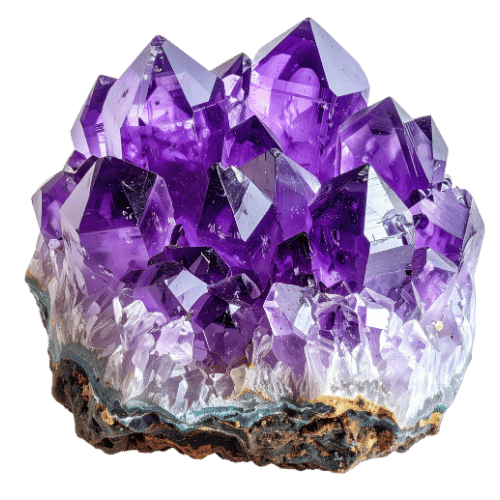
Amethyst is the stone of mental clarity, spiritual awareness, and the third eye. In Christian symbolism it represents bishops, who traditionally wore amethyst rings as a sign of pastoral authority. The English regalia includes multiple amethysts. In modern crystal healing, amethyst is associated with the crown chakra and is the most-recommended stone for meditation, dream work, and breaking addictions. Wearing amethyst is said to enhance intuition, calm anxiety, and promote restful sleep. The deepest purple amethyst — called Deep Russian or Siberian color — is the most valued; lighter lavender stones are called Rose de France.
Famous Amethysts in History
The Delhi Sapphire — actually a magnificent amethyst — was looted from a Hindu temple during the Indian Mutiny of 1857. Its English owners reported a series of misfortunes that led one to write a letter (sealed inside the gem's box) warning future owners. The Empress of Uruguay is the world's largest amethyst geode at 11 feet tall. The Russian Imperial Crown contains multiple amethysts gifted to Catherine the Great, who reportedly owned amethysts the size of plums. The Tiffany & Co. amethyst-and-diamond necklace owned by Wallis Simpson sold at auction in 2010.
How to Care for Amethyst
Amethyst is hardy (Mohs 7), suitable for daily wear, but can fade with prolonged UV exposure — keep amethyst rings out of direct sun for hours at a time. Heat treatment converts low-quality amethyst into yellow citrine; this is why most commercial citrine is actually heated amethyst. Clean with warm water and mild soap. Ultrasonic cleaners are safe for untreated amethyst but should be avoided for any treated material. Store separately from harder stones (diamond, sapphire, ruby) to prevent scratching.
Names That Connect to Amethyst
Amethyst's purple wisdom resonates with names meaning sage, violet, divine intuition, and moon-energy.
Amethyst — Common Questions
What makes amethyst purple?
Amethyst is purple due to trace amounts of iron (Fe³⁺) in the quartz crystal lattice, combined with natural radiation that occurs over millions of years in the host rock. Without the radiation, the iron-bearing quartz would be colorless or pale yellow. Heat treatment can break this chromophore — turning purple amethyst into yellow citrine.
Is amethyst expensive?
After the 19th-century Brazilian discoveries, amethyst became affordable for ordinary buyers. Today good-quality amethyst sells for $20-100 per carat (compared to $1,000+ for fine sapphire). However, deeply saturated Russian-color amethyst from rare deposits can sell for $50-200 per carat. The geode form (clusters in cathedral form) is also valuable.
Can amethyst protect against drunkenness?
The ancient Greek belief is myth — drinking wine from an amethyst cup will not change its alcoholic effects. However, amethyst remains symbolically associated with clarity, restraint, and breaking addictions, and many people in addiction recovery wear amethyst as a meditative reminder of sobriety.
What zodiac signs benefit from amethyst?
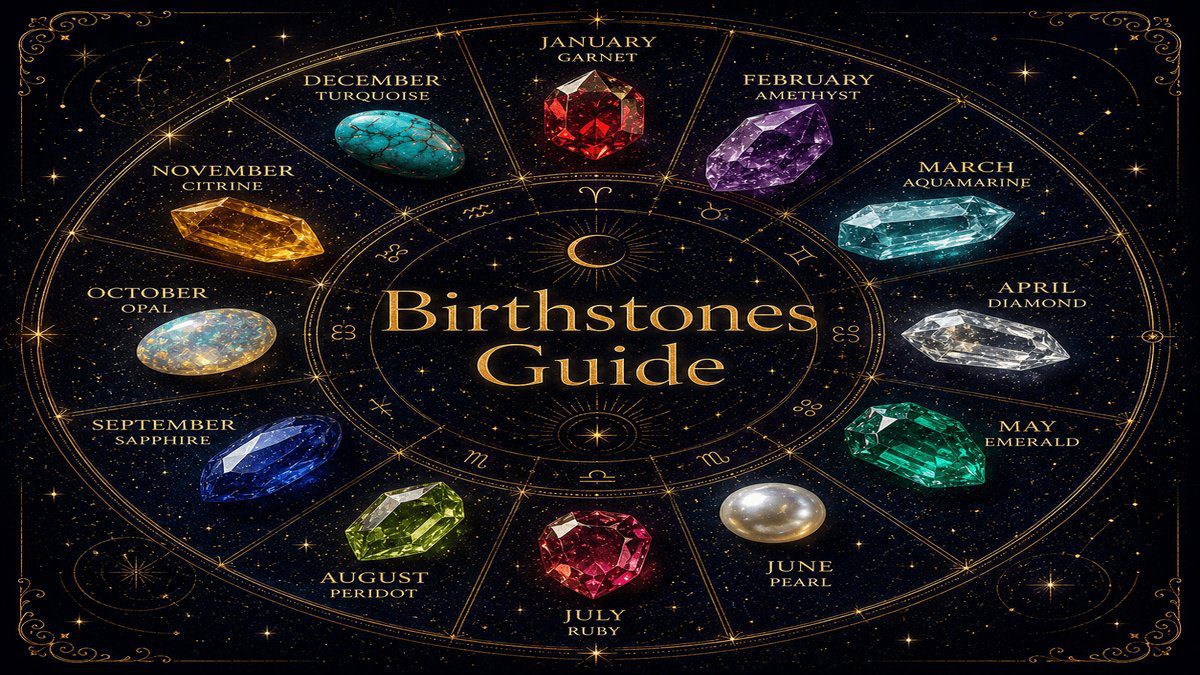
Amethyst is the February birthstone (Aquarius and Pisces). In Vedic astrology, amethyst is associated with Saturn and benefits Capricorn and Aquarius natives. In broader practice, it is recommended for water signs (Cancer, Scorpio, Pisces) for emotional balance and for air signs (Gemini, Libra, Aquarius) for clarity of thought.
How can I tell if amethyst is real?
Real amethyst is hard (scratches glass), has natural color zoning visible under bright light, and refracts light through its crystal structure with mild birefringence. Synthetic amethyst (lab-grown) is chemically identical and very difficult to distinguish without gemological equipment. Glass imitations are softer and lack birefringence — they show no double image when viewed through a 10x loupe.
Other Stones to Explore
More Cosmic Tools
Find Your Birthstone by Birth Month
Each month has its own stone with unique meaning, history, and healing energy. Tap your birth month to discover yours in detail.
💎 Bringing Amethyst Into Your Practice
Reading about Amethyst activates one part of you. Holding Amethyst activates an entirely different part. Ancient cultures across continents independently established the same truth: the stone in the hand does what the stone in the mind cannot.
Choose Your Format
- Tumbled Amethyst ( to 14) for pocket carry and meditation.
- Raw Amethyst ( to 32) most powerful energetically for altar or desk.
- Amethyst Bracelet ( to 35) daily-wear, energy active 24/7.
- Amethyst Pendant ( to 45) over heart chakra for emotional work.
Authenticity Quick Check
Verify: weight (denser than expected), temperature (cool in palm 30+ sec), color depth (natural variation, not uniform). Avoid mixed-category sellers and prices under .
Caring for Your Stone
Amethyst absorbs ambient energy continuously. Weekly cleansing required. The simplest tool: a Selenite charging plate ( to 22). Place crystals on it overnight. See our complete cleansing guide for 6 more methods.